
Financing Conditions Explained
What buyers and sellers should know about mortgage approval, appraisals and requests for more time.

A financing condition gives a buyer time to obtain a satisfactory mortgage commitment before being required to complete the purchase. It is an important protection, but it can also be a source of stress when a lender asks for one more item—especially an appraisal—close to the subject-removal deadline.
When that happens, a buyer may need to request a short extension. Understandably, sellers can feel frustrated. But a late lender request does not necessarily mean the buyer was unprepared or slow to provide documents.
What a Financing Condition Means
An accepted conditional offer is a binding contract, but the buyer's obligation to complete remains subject to the condition written into that contract. The buyer must make reasonable efforts to obtain financing by the stated deadline; it is not simply an opportunity to change their mind.
Once the buyer is satisfied with the financing commitment, the condition can be removed in writing. Removing it without adequate approval can expose the buyer to serious risk if the mortgage later falls through.
Pre-Approval Is Not Final Approval
A pre-approval primarily considers the buyer's income, debts, credit and down payment. Final mortgage approval also considers the specific property being purchased. The home is the lender's security, so the lender must be comfortable with both the borrower and the property.
Why might a lender order an appraisal?
An appraisal helps the lender assess the property's current market value and whether it supports the requested loan. Depending on the property and the lender's process, that request may arise after the accepted contract has already been submitted for review.
Rural acreage, unusual construction, limited comparable sales, suites or other distinctive features can sometimes require a closer valuation review. The timing and requirements are ultimately controlled by the lender and its underwriters—not by the buyer or their real estate agent.
When More Time Is Needed
If the appraisal or final underwriting cannot be completed before the financing deadline, the buyer can request an extension. An extension is not automatic: the seller must agree, and the change should be documented in writing before the existing deadline.
A focused request helps everyone make an informed decision. It should explain the length of time needed and, where appropriate, whether the appraisal has been ordered or completed and whether financing is otherwise progressing. Privacy still matters, so buyers are not expected to disclose their entire financial file.
What Each Side Should Know
For Buyers
Have documents ready, send the accepted contract and property information to the lender immediately, respond quickly to follow-up requests and keep your agent updated. Ask early whether a valuation may be required—but recognize that even a well-prepared file can encounter a late underwriting request.
For Sellers
A request for a short extension does not automatically mean the buyer failed to prepare. Ask what step remains, how much time is requested and whether there is evidence of progress. Then consider the request in light of your timing, other interest in the property and professional advice. The decision remains yours.
Preparation Helps, but Not Every Delay Can Be Avoided
Financing approval is a process, not a single yes-or-no conversation. Good preparation reduces delays, but it cannot eliminate every lender request. Clear communication, realistic subject timelines and a little perspective can prevent a routine appraisal delay from becoming an unnecessary conflict between buyers and sellers.
Learn More About Financing & Conditions
Questions About a Conditional Offer?
We can help you understand the timeline, communicate clearly and work through the next steps with your mortgage and legal professionals.
Contact Bennett Family Real Estateinfo@nelsonproperty.com
This information is provided as a general resource only. Contract wording and individual circumstances vary. Obtain advice from your real estate, mortgage and legal professionals before making a decision.
|
Kootenay Property Guide
Septic Systems 101
What Kootenay homeowners, buyers and sellers should know about septic systems, maintenance, records and real estate transactions.

Many rural and semi-rural homes throughout the Kootenays rely on an onsite septic system instead of a community sewer. It may be out of sight, but it is an important part of the property—and one that deserves attention well before a real estate transaction reaches the closing table.
A little knowledge, regular maintenance and clear documentation can help protect the system, reduce surprises and give buyers and sellers more confidence throughout the process.
The Basics
How Septic Systems Work
Wastewater leaves the home and enters a watertight septic tank. Heavy solids settle to the bottom as sludge, oils and lighter material form a layer at the top, and naturally occurring bacteria begin breaking down the waste.
The liquid between those layers then flows to a dispersal area—often called a septic field—where pipes or chambers distribute it into the soil for further treatment. The tank and field work together, which means both need to be located, protected and maintained.
Looking After Your System
Maintenance & Pumping
Follow the maintenance plan prepared for your system and keep service records. B.C. guidance says systems usually need servicing every two to five years, although the appropriate timing depends on the type of system, tank size, household use and what goes down the drain.
Simple ways to protect your septic system
- Repair leaking taps and toilets.
- Spread out heavy water use where possible.
- Keep vehicles and structures off the septic field.
- Direct surface water away from the system.
- Avoid planting large trees close to the field.
- Never flush grease, wipes, paint, solvents or other harmful materials.
Slow drains, sewage odours, unusually green or wet areas, pooling water or backups deserve prompt attention from a qualified professional.
For Buyers
What Buyers Should Investigate
Ask what type of system serves the property, when it was installed, where the tank and dispersal area are located, and what occupancy or wastewater flow the system was designed to handle.
Review any available as-constructed drawings, maintenance plans, Letters of Certification, pumping history, servicing records and repair information.
Buyers may also want to consider an inspection by an appropriately qualified Registered Onsite Wastewater Practitioner (ROWP), particularly when records are incomplete, the system is older, warning signs are present or future additions are being considered.
For Sellers
Records Worth Gathering
Gathering septic information before listing can make it easier for buyers to understand the system and review the property with greater confidence.
- Interior Health filing or Record of Sewerage System
- Letter of Certification
- As-constructed drawing or site plan
- System maintenance plan
- Pumping and servicing records
- Inspection and repair receipts
- Details of known alterations or previous issues
The more relevant information you can provide, the easier it can be for buyers to understand the system. If documents are missing, consider requesting an Interior Health file search early. Older records are not always available and diagrams may be incomplete, so allowing time for follow-up can help prevent delays.
The Takeaway
Good Records Can Make a Difference
Whether you already own a Kootenay property or are considering buying one, knowing where the septic system is located, understanding how it has been maintained and keeping the available documentation together can make future maintenance—and future real estate transactions—much easier.
Helpful Resources
B.C. Septic Information
These provincial and professional resources are useful starting points for homeowners, buyers and sellers looking for more information.
HealthLinkBC — Maintenance & Operation of Onsite Sewage Systems → Interior Health — Onsite Sewerage & Record Requests → ASTTBC — Find a Registered Onsite Wastewater Practitioner →Bennett Family Real Estate
Buying or Selling a Kootenay Property?
We can help you ask the right questions, organize the information available for a property and connect you with qualified local professionals when septic details matter.
Contact Bennett Family Real EstateThis information is provided as a general resource only. Septic systems and individual properties vary. Consult an Authorized Person and appropriate real estate and legal professionals for advice specific to your property or transaction.
More sales. Stable prices. Plenty of choice.
July brought renewed activity to Nelson and the surrounding Kootenay real estate market—but buyers continued to negotiate.
Explore the July numbersA welcome burst of summer activity.
Thirty-nine properties sold in July—30% more than last July and above the five-year July average of 33 sales.
That momentum is encouraging, but it has not yet erased the year's slower start. Year-to-date sales remain below 2025 levels.
July was active, but it was not a runaway seller's market. Prices were nearly unchanged, inventory remained high and buyers retained negotiating room.
Key July market numbers.
July 2026 results compared with July 2025.
Momentum improved, while balance remained.
A strong July within a slower year
July's 39 sales rose from 30 last year and edged above June's 38. The closed-to-new-listing ratio reached 54.2%, up from 43.5% last July. However, year-to-date sales remain 10.58% below 2025, at 186 compared with 208.
Prices are stable, not surging
The average sold price finished at $658,002, only 0.71% above July 2025. The largest concentration of activity was between $575,001 and $750,000, with 10 transactions.
Buyers still have negotiating room
Sellers achieved an average of 95.55% of asking price, down from 96.61% last July. Average days on market rose modestly to 63.44 days, showing that buyers remain selective and price-sensitive.
Selection remains high
July ended with 354 active listings and 12.57 months of supply. Buyers have meaningful choice, while sellers continue to benefit from strong presentation and realistic entry pricing.
| Metric | July 2026 | Year over year |
|---|---|---|
| Sold listings | 39 | +30.00% |
| New listings | 72 | +4.35% |
| Average list price at closing | $684,042 | -0.24% |
| Average sold price | $658,002 | +0.71% |
| Percentage of list price achieved | 95.55% | -1.10% |
| Average days on market | 63.44 days | +4.05% |
| End-of-month inventory | 354 homes | +0.57% |
| Months of supply | 12.57 MSI | +3.25% |
Review the full July market information.
Open the complete report or browse the properties reported sold during July.
What do these numbers mean for your plans?
Every price range and property type moves differently. Connect with us for thoughtful local guidance based on your goals.
Email Bennett Family Real EstateWhat the headline numbers don’t tell you.
A closer look at Nelson and area real estate—and the unusual sales that reshaped this month’s averages.
An active start to summer.
Hi from Bennett Family Real Estate. We hope you are having a wonderful start to your summer.
June was an incredibly active and busy month for our team on the ground, and we have loved helping so many families navigate their local Kootenay property moves.
If you looked only at the headline statistics, you might have done a double-take. Average sold prices rose by more than 55%, while the average time to sell nearly doubled. Those figures look dramatic—but a closer look reveals a much more nuanced summer market.
Market at a glance.
Eight indicators offer a useful snapshot, but several were strongly influenced by a small number of unusual sales.
What the data reveals.
A cluster of ultra-luxury closings and several exceptionally long-listed properties had an outsized effect on June’s averages.
The luxury surge
The average sold price climbed to $882,918, but this does not indicate rapid price inflation across every segment. Only ten residential properties sold above $1.9 million in the area over the previous three years; four of those ultra-luxury sales closed in June alone, pulling the mathematical average sharply upward.
The days-on-market mirage
Average time to sell reached 112 days. A few highly distinctive heritage and specialty properties—some marketed for more than two years—finally found buyers. Closings with more than 700 and 1,000 days on market can reshape the average even while more typical homes move considerably faster.
Stable active inventory
June ended with 338 active units, almost unchanged from 339 one year earlier. At 12.33 months of supply, buyers have meaningful summer selection, while sellers benefit from thoughtful preparation and pricing grounded in the current market.
“Raw averages can tell part of the story. Local context explains the rest.”Bennett Family Real Estate
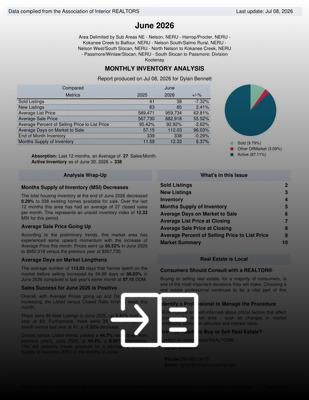
Explore the full market report and recent sold activity.
The full digital report brings the June statistics and recent sold properties together in one place. Use it as a starting point, then speak with our team about how the numbers relate to your particular property or plans.
Open the Digital ReportLocal guidance starts with the right context.
Real estate is local, and the numbers never tell the whole story. Let’s discuss how current conditions may affect your Kootenay property goals.
Ask Bennett Family Real EstateMarket statistics are provided for general information and may be revised. Individual properties and neighbourhoods can perform differently from broader market averages.
|
|
|
|
|
|
|
|
The assessment versus reality gap.
Why a higher BC Assessment may not reflect what your Nelson-area property would sell for today.
Understand the numbersAssessment values rose while sale prices softened.
BC Assessments recently increased by an average of 3% across Nelson and the surrounding rural areas.
If that feels out of step with current market headlines, you are not alone. The explanation lies in the period of sales data used to calculate assessed values.
An assessment is based on an earlier snapshot of the market. Current value is better understood through recent, comparable sales.
Three numbers tell the story.
The timing of the data explains why an assessment can rise even after the market changes direction.
Prices rose 4.6%
BC Assessment looks at data from July 1 to June 30. During that particular period, local prices increased.
Prices fell 8.3%
During the second half of 2025—from July through December—sold prices moved significantly lower.
2025 ended down 3.7%
The assessment still reflects earlier growth, while the full calendar year captures the later market softening.
More properties sold across the region.
A total of 360 properties sold during 2025—an increase of 7.8% over the previous year. Growth was concentrated in rural residential and land sales.
| Category | Units sold | Annual change |
|---|---|---|
| Town residential | 154 | -4.4% |
| Town land | 4 | -20.0% |
| Rural residential | 145 | +14.2% |
| Rural land | 44 | +29.4% |
| Total area sales | 360 | +7.8% |
Sales increased, while prices softened.
The late-2025 shift affected average prices across the market's major categories.
Average sold price, down 4.4%.
Average sold price, down 2.2%.
Building costs continued to weigh on demand for raw land.
A resilient market enters 2026.
Despite the year-over-year price decrease, total sales rose 7.8% and average days on market remained stable. The overall average sold price of $649,705 was still the second-highest recorded in the past five years.
Start with a clearer picture of your property's value.
Market value is best informed by recent comparable sales—not an assessment alone. Connect with us for thoughtful, local guidance.
Email Bennett Family Real Estate
|
|
|
|
|